
Overview
In a typical Shopify store, about one in eight first-time customers orders again within 90 days, and more than one in five (22%) within a year. The repeat purchase rates below come from more than 40,000 first-time customers at Shopify stores that use Ordinary, as of November 2026.
Benchmarks
What is a good repeat purchase rate?
It depends on how long you give customers to come back. Here is the share of first-time customers who placed a second order within each window, for the typical store and for the middle half of stores.
| Came back within | Typical store | Middle half of stores |
|---|---|---|
| 30 days | 7% | 4–11% |
| 60 days | 11% | 7–19% |
| 90 days | 13% | 8–22% |
| 180 days | 17% | 11–27% |
| 365 days | 22% | 12–30% |
So a 90-day repeat purchase rate above about 22% puts a store in the top quarter, and one under about 8% in the bottom quarter. What counts as good depends heavily on what you sell.
By category
Repeat purchase rate by category
Products that run out bring customers back. Supplements are bought on a cycle, so their repeat purchase rate (also called the repeat customer rate) keeps climbing steeply for a year. Food, drink and beauty climb more slowly after the first 90 days.
| Category | 90 days | 180 days | 365 days | Typical days to 2nd order* |
|---|---|---|---|---|
| Supplements and wellness | 35% | 44% | 56% | 55 |
| Beauty and personal care | 20% | 24% | 30% | 38 |
| Food and drink | 19% | 23% | 26% | 42 |
| Household essentials | 10% | 13% | — | 43 |
Category figures count every first-time customer in the category together. A dash means fewer than 500 customers had a full year to come back, which is too few for a steady rate. *Among customers who came back within a year (within 180 days for household essentials).
Timing
Most second orders come within 90 days
Across all the customers who ordered again within a year, the typical one did so after 44 days. 37% came back within 30 days, 60% within 60 days and 73% within 90 days. After 90 days without a second order, most of the customers who will return already have.
That makes the first three months the window that matters most for post-purchase emails, replenishment reminders and second-order offers. Time them to your own gap between orders, not to a calendar.
Shopify's returning customer rate
Why Shopify shows a higher number
Shopify's returning customer rate answers a different question. It takes everyone who ordered in the period you pick and counts the share who had ordered before. A loyal base keeps ordering every month, so it fills that number even when few new customers ever come back.
The repeat purchase rate on this page starts from new customers and asks how many came back. Over the last 90 days the typical store's returning customer rate, worked out the way Shopify defines it, was 35%, while its 90-day repeat purchase rate is 13%. In most stores the returning customer rate is well above the repeat purchase rate.
Neither number is wrong. To compare yourself with the benchmarks above, use the repeat purchase rate. To see how much of a month's sales came from people who had bought before, use Shopify's returning customer rate. And if you're asking what a good returning customer rate is for your store, compare it with your own earlier months: it rises with every loyal customer you already have, so another store's figure says little about yours.
Formula
How to calculate repeat purchase rate
Pick a window, such as 90 days. Take every customer whose first order was at least 90 days ago, so each of them has had the full window to come back. Then:
repeat purchase rate = customers who placed a second order within 90 days of their first ÷ all those customers
From a Shopify orders export, take each customer's first order date and their second, if they have one. Leave out customers whose first order is more recent than the window. Counting them as customers who never came back pulls the rate down.
What a point is worth
What one more point of repeat rate is worth
Take a store that wins 2,000 new customers a year, where a customer who comes back places 1.5 more orders in the year, at $55 each. One more point of repeat rate is 20 more returning customers:
20 customers × 1.5 orders × $55 = $1,650 more revenue a year
Repeat orders cost no new-customer ad spend, so far more of that is margin than on a first order. It also changes what you can pay for a new customer: work out break-even ROAS to see how repeat orders lower the ROAS a new-customer campaign needs, and customer lifetime value adds them up over a longer period.
First-order discounts
Do discounted first orders come back?
Across all customers, 40% of first orders used a discount. In the typical store, those customers came back less often: 20% ordered again within a year, against 27% of customers who paid full price. The gap varies a lot from store to store, so check yours before you change an offer.
Your store
Compare your store with the benchmark
See your own repeat rate, by first product
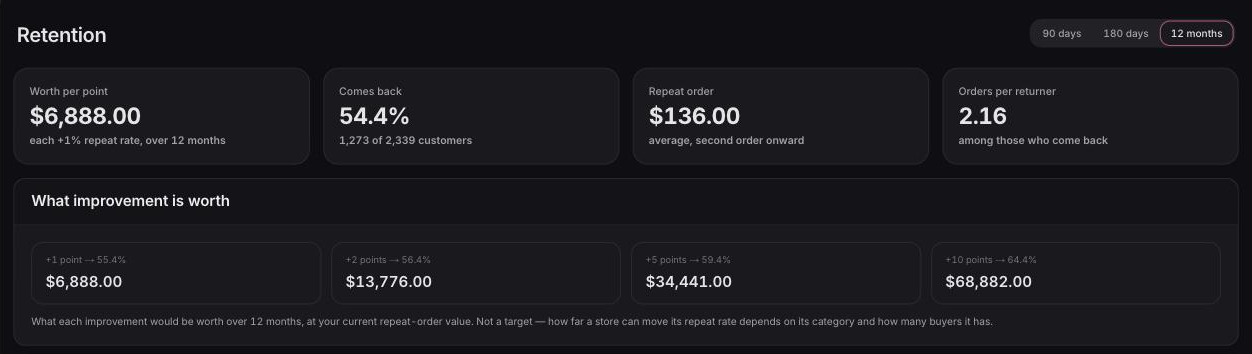
Ordinary's Retention report shows your store's repeat purchase rate measured the same way, from each customer's first order over a fixed window, what one more point of it is worth, and what new customers bought next.
Follow each group over time
Cohorts, on the Advanced plan, group customers by the month or the product they started with, so you can see whether newer customers come back as often as older ones.
How these benchmarks were built
Anonymised, aggregated orders from Shopify stores that use Ordinary, as of November 2026. A customer counts from their first order. Only customers whose first order is at least one full window old are included. Test and cancelled orders are left out, and each store's first six months of history are skipped so earlier customers aren't counted as new. "Typical store" is the median of each store's rate, and "middle half" runs from the 25th to the 75th percentile. The page is refreshed as more stores join.
The Retention report is available on every Ordinary plan, including Free.
 Connect your store