
Overview
Ad platforms report the sales they can claim. On Meta, by default, that includes view-through conversions from shoppers who never clicked. Your Shopify orders show the sales you can trace to a click. Put the two side by side and you see which platform's number runs furthest ahead of your store's. A holdout test is the most direct way to measure what each platform caused.
Three numbers
No single number tells you which platform is working
Sooner or later an agency or a founder asks: which platform is working, which one is only taking credit, and by how much? Three numbers answer that, and each answers a different part.
| Number | What it counts | What it answers |
|---|---|---|
| Platform-reported | Purchases the ad platform credits to its ads, under each ad set's own attribution setting | Which ads and audiences win inside that platform |
| Store-attributed | Your Shopify orders traced to a click on that platform's ads, under one attribution model for every channel | How the platforms compare with each other, on the same orders |
| Incremental | The sales that disappear when the ads are held back, measured with a holdout test | What the ads caused |
None of these is wrong. They are different measurement systems, and they disagree because they count different things.
Click-through vs view-through
What is a view-through conversion?
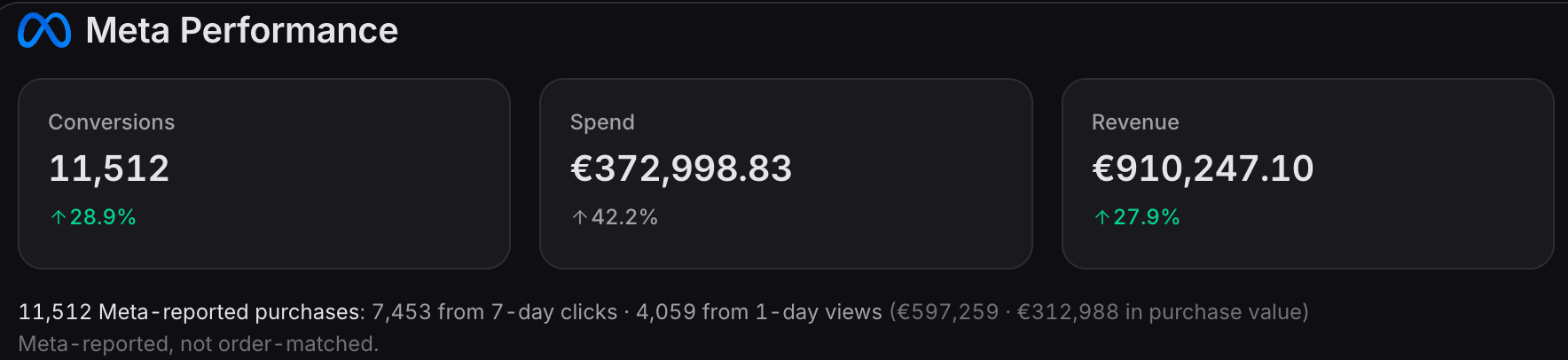
A view-through conversion is a purchase credited to an ad the shopper saw but didn't click. Click-through conversions are purchases made after clicking a link in the ad. Meta counts a view-through purchase within 1 day of the ad being shown, and a click-through purchase within 1 or 7 days of the click. Its default setting counts both, plus purchases within 1 day of an engagement such as a video play. Each ad set can have a different setting.
Google Ads counts view-through purchases separately and leaves them out of its purchase conversions. That's one reason Meta's reported number can run further ahead of your store than Google's.
Facebook ads attribution
Why a platform's number often runs ahead of your store's
Facebook ads attribution counts more than the clicks that reach your store. Five things explain much of the difference.
Seeing an ad can count
Meta's default setting credits a purchase made within 1 day of someone seeing an ad, without a click. A shopper who never clicked never arrives at your store from that ad.
An engagement can count
Meta also counts purchases within 1 day of a click that isn't on the ad's link, or of five seconds of a video. That shopper may never reach your store from the ad either.
The platform counts the person, not the visit
A shopper can click your ad in Instagram on their phone, then buy days later on a laptop. Meta can connect those two moments and count the purchase as a click-through sale.
Some results are estimated
Meta says it may use statistical modeling for some results it can't measure directly. A modeled purchase is an estimate, not an order you can open in Shopify.
More than one platform can claim the same order
Meta doesn't know about the Google search or the email that came after its ad, and Google doesn't know about the ad. Each can credit the order to itself. Your store's view uses one attribution model for every channel, so the channels are compared on the same basis.
Views aren't the whole gap. Meta's click-through count can differ from your store's too, because Meta counts people across their devices and estimates some results. So a gap that remains with views set aside is normal, not a sign that either number is broken.
An illustrative month
Reading the gap
Here's a made-up month for one store:
| Platform | Platform-reported | Store-attributed | Gap |
|---|---|---|---|
| Meta | 420 purchases | 250 orders | 170 (about 40% of what it reports) |
| Google Ads | 310 purchases | 265 orders | 45 (about 15%) |
On the platforms' own numbers, Meta wins by 110 purchases. On the store's orders, Google is ahead by 15. Meta reports 170 more purchases than the store attributes to it; Google reports 45 more. That doesn't make Meta's 170 fake. A shopper who saw an ad, or clicked on a phone and bought on a laptop, can be a real sale the ad earned. It tells you which number to question first, and where a holdout test is worth running.
In Ordinary
How to compare the platforms in Ordinary
Put each platform's claim next to your store's
Channels → Meta and Channels → Google Ads each have a Click-through / View-through toggle. Click-through shows the Shopify orders traced to that platform's clicks, under the attribution model you pick. View-through shows the platform's own reported purchases, which include its clicks as well as its views. For Google, view-through purchases are shown as a separate count. Meta ad attribution gets one more line when Meta provides it: its own split of the total into 7-day clicks and 1-day views.
Check which platform finds new customers
Ad platforms take credit for repeat buyers too. On Advanced, Cohorts shows each channel's new customers with the ad spend, cost per new customer and acquisition ROAS behind them, and how much of that cost they've paid back since. A platform that claims plenty of sales but brings in few new customers may be getting credit for buyers who were already yours. That's worth testing.
Compare the channels on the same orders
Marketing Mix shows every channel's attributed orders and revenue for the same days, under one model, with ROAS where there's ad spend. It's where Meta and Google meet your email, organic and direct sales on equal terms.
Watch total revenue when spend moves
Divide your total store revenue by your total ad spend for the same days. That's your MER. Raise one platform's budget for a few weeks. If the sales it claims climb but your total store revenue barely moves, the extra spend may be earning credit more than new sales. That's the platform to test first.
Switch the attribution model
Compare First-touch with Last-touch. A channel that gains on First-touch tends to bring shoppers in; one that gains on Last-touch tends to close the sale. If the two barely differ for a channel, the models agree about it, so the gap with the platform's own number isn't about how credit is split between your channels.
Attribution vs incrementality
The test built to measure what an ad caused
Attribution tells you which ads were there before a sale. Incrementality asks whether the ads made it happen. Every number above, the platform's and your store's, is attribution. Neither tells you whether the shopper would have bought anyway.
Incrementality testing is how you answer that: hold the ads back from a group and compare. Some platforms run lift studies that keep a random group of people from seeing your ads. You can also run a geo holdout yourself: pause a platform in a few regions for several weeks and compare their Shopify sales with similar regions where the ads kept running. You need enough orders in each region for the difference to mean anything, so smaller stores may not get a clean answer.
Until you've run one, the gap between claimed and store-attributed sales is a lead. It tells you where to test first.
Cheat sheet
Which number answers which question
| Question | Use |
|---|---|
| Which Meta ad or audience is winning? | Meta's own numbers, comparing ads with each other. |
| How do Meta and Google compare on the same orders? | Store-attributed orders for both, under the same model and the same days. |
| Which platform is finding new customers? | New customers and cost per new customer, by channel. |
| Is the extra spend paying off? | Total store revenue against total ad spend, as spend changes. |
| What did the ads cause? | A holdout test. |
Meta's and Google's claims next to your orders
Ordinary starts from your Shopify orders and puts Meta's and Google's own numbers beside them, so you can see how far each platform's claim runs ahead of your store, and where to test first.
Marketing Mix is on every Ordinary plan, including Free, where it shows each channel's orders, revenue and AOV. The Meta and Google Ads connections, with ROAS and the Click-through / View-through toggle, are on Starter and above. Cohorts is on Advanced.
 Connect your store